InhA
InhA is a NADH dependent enzyme found in the FAS-II (fatty acid synthesis II) pathway unique to bacteria, mycobacteria, and parasitic protozoans. InhA catalyzes one of the final steps in the fatty acid elongation pathway and is the target of one of the primary first line tuberculosis antibiotics, Isoniazid. The drugs ethionamide and prothionamide also target InhA. It is one of the best validated targets for treating tuberculosis and the object of intense research effort. In other bacteria, the homologous enzyme is called FabI.
Protein, co-factors, and natural substrate
InhA catalyzes the hydrogenation of an unsaturated enoyl-ACP to a saturated acyl-ACP. It is one of the final steps in the elongation pathway and the likely rate limiting. NADH is the required co-factor and provides a source of binding interactions with the substrate and contributes to the reduction by donating a hydrogen upon tranformation to NAD+.
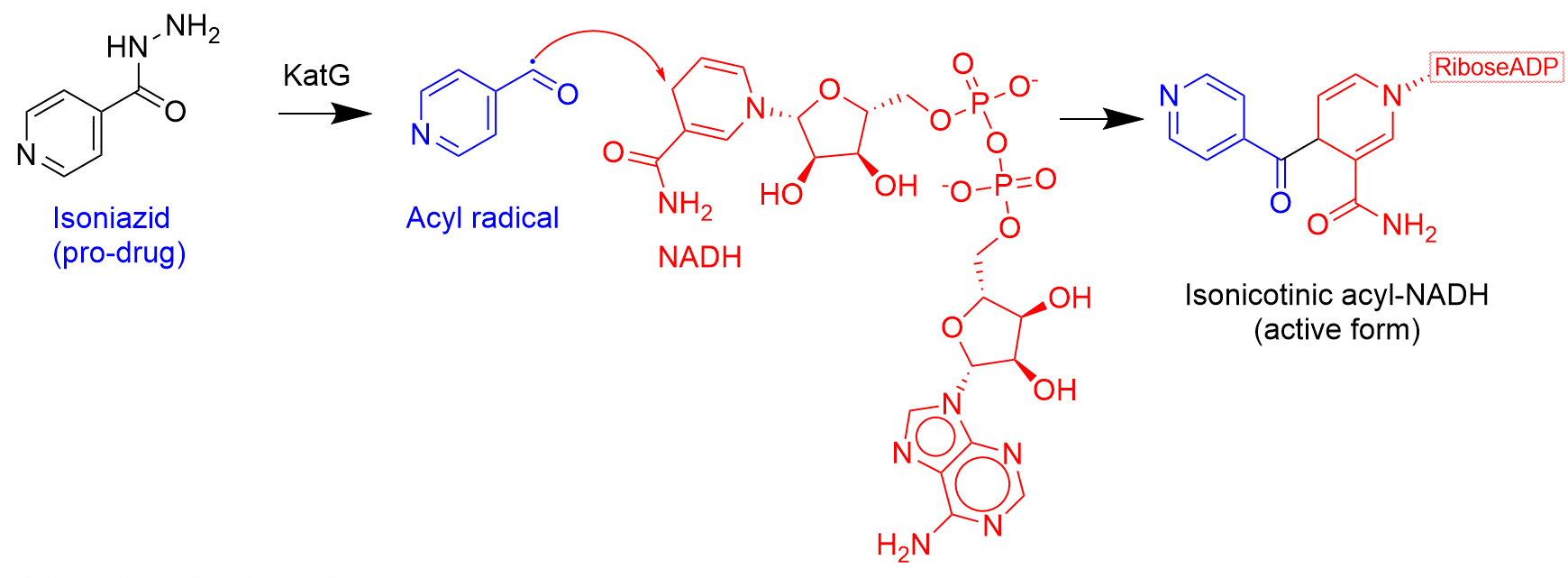
Isoniazid acts as a pro-drug, getting activated by enzyme KatG to an acyl radical before it irreversibly reacts with NADH. The adduct is then a tight binding reversible inhibitor of InhA.
InhA
Available crystal structures
There are many crystal structures of InhA in the pdb database. A brief selection is summarized below.
Table 1 - InhA apo structures
| pdb | year | resolution | notes |
|---|---|---|---|
| 4TRM | 2015 | 1.8 | Only true apo (no NAD) |
| 4TRN | 2015 | 2.0 | NAD bound |
| 1ENY | 1996 | 2.2 | NAD bound |
Table 2 - A selection of co-crystal structures
| pdb | year | resolution | ligand1 | ligand2 | notes |
|---|---|---|---|---|---|
| 1ENY | 1996 | 2.2 | NAD | - | |
| 1ZID | 1998 | 2.7 | Isonicotinic-acyl-nadh | isoniazid adduct | |
| 1BVR | 1999 | 2.8 | NAD | C16-Substrate | Bound product? |
| 1P44 | 2003 | 2.7 | NAD | - | |
| 2B35 | 2006 | 2.3 | NAD | Triclosan | |
| 2B36 | 2006 | 2.8 | NAD | 5-pentyl-2-phenoxyphenol | |
| 2H9I | 2007 | 2.2 | ETH-NAD | ||
| 4TRO | 2015 | 1.4 | NAD | Isoniazid-active | Highest resolution |
| 5MTQ | 2017 | 2.6 | NAD | PT511 | Most complete |
| 9RJG | 2026 | 1.7 | pyridomycin | Most recent |
Inhibitors
Isoniazid is key piece in first line treatment, often paired with ethambutol, pyrazinamide, and rifampin.
Table 3 - approved drugs with InhA activity
| drug | First Use | clinical use | notes |
|---|---|---|---|
| Isoniazid | 1953 | Primary | pro-drug with KatG activation |
| Ethionamide | 1956 | MDR | pro-drug with EthA activation |
| Prothionamide | 1960 | MDR | pro-drug EthA activation |
Other known and potential inhibitor classes identified from work with InhA and the homologous FabI include: Triclosan, Coumarins, Phenoxypyrones, Pyridones, Pyrazoles, Imidazoles, and many others. See the review by Bibens et al for a good breakdown.
Key interactions
A common thread of most inihibitors is strong interactions with the active site Tyrosine 158 and the bound NAD. Other interactions vary based on inhibitor class.
Equilibrated Computational Structures
Citations
- Bibens, Laurie, Jean-Paul Becker, Alexandra Dassonville-Klimpt, and Pascal Sonnet. “A Review of Fatty Acid Biosynthesis Enzyme Inhibitors as Promising Antimicrobial Drugs.” Pharmaceuticals 16, no. 3 (2023): 425. https://doi.org/10.3390/ph16030425.
Edited: 6/10/2026 by Gregory Smith